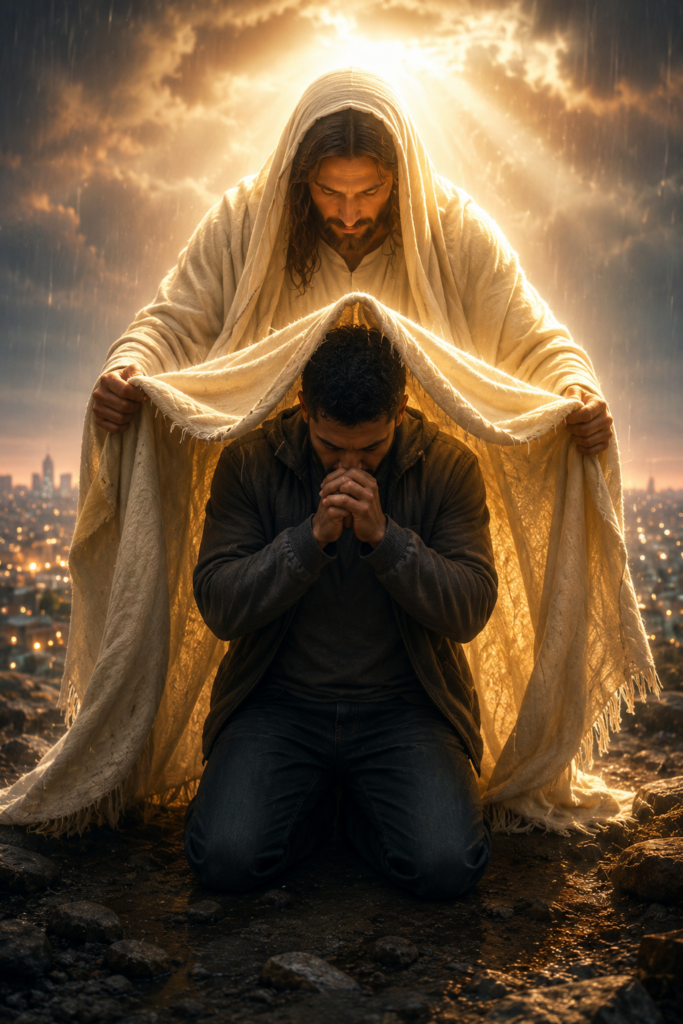
It was 6am, dark outside, the kind of stillness that only exists before a city wakes up. We were praying, and Shawna began to sing, unplanned, unrehearsed, the way the Spirit sometimes moves through a room before anyone has decided to lead. The words were simple:
“I give up my control, oh God.”
I have sung surrender songs my whole life. I have preached on surrender. But something about that particular morning, that particular phrase, landed somewhere deeper than my theology. It landed in my body. And what surfaced was not abstract; it was specific. I realized that somewhere along the way, without ever declaring it out loud, I had appointed myself the protector of my own life. Not because I stopped believing in God’s goodness, but because somewhere in my history, protection had not arrived when I needed it, or it had not arrived in the form I expected, and my nervous system drew its own conclusion: the job is mine.
The Seat That Was Never Meant for Me
There is a seat in the universe reserved for God alone: the seat of ultimate protector, the one who holds the world together, the one whose job it is to guard what he loves. Scripture is not shy about this. Psalm 121 says the one who watches over Israel neither slumbers nor sleeps. Isaiah 42:8 says God shares his glory with no other. Protection, like glory, belongs to God in a category all its own.
And yet this is precisely the seat we are tempted to climb into.
Go back to the Garden. The serpent’s offer to Eve was never crude; it was elegant. “You will be like God.” Not “you will rebel against God,” but “you will occupy his place.” The original sin was not merely disobedience; it was displacement, reaching for a position that belonged to another. Adam and Eve did not trust that God’s boundary was for their good, so they took the fruit and, in effect, took the job. They decided they would determine good and evil themselves. They would manage their own outcomes. They would protect themselves from whatever lack they feared God’s instruction might create.
I think this is the oldest pattern in the human heart, and I think I have been living inside it longer than I realized. Not with pride that shouts, but with pride that whispers: if I don’t guard this, no one will.
Where the Protector Was Born
For most of us, the protector role is not chosen; it is birthed. It is birthed in a childhood moment when comfort didn’t come and a small nervous system learned to brace instead of rest. It is birthed in a betrayal that taught us vigilance where we once had trust. It is birthed in a season where we prayed and prayed and the danger did not lift, and some quiet part of us concluded, without ever saying it in a sentence, that God’s protection was theoretical and our own effort was the only thing we could actually verify.
None of these origins are shameful. They are, in fact, deeply human, and often the fruit of real wounds, not imagined ones. This is where I want to be careful, because there is a difference between naming an illusion and dismissing real pain. The reasons we built the protector seat are usually legitimate. The hurt was real. The absence, in the moment, felt real. But a legitimate wound does not make a permanent posture wise. It only explains how the posture got built.
Pride Doesn’t Protect. It Exhausts.
Here is what I am slowly seeing, gently, without self-condemnation: the self-protection I built was never actually sustainable. It could not be, because it was never designed to carry the weight I gave it. Only God’s shoulders were built for that load.
Pride is usually pictured as arrogance, chest out, chin up. But there is a quieter form of pride that looks like exhaustion: the pride of believing that if I don’t manage this, hold this, brace for this, it will fall apart. That is still pride. It is still me in the seat that belongs to God. And it comes with no joy, because vigilance and joy cannot occupy the same body at the same time. You cannot stay braced and stay at rest simultaneously. I have felt this in my own body for years without having language for it: the low hum of tiredness that isn’t about hours slept but about a system that never fully stood down.
The Cruciform Alternative
Philippians 2 gives us the only sustainable pattern I have found. Jesus, existing in the form of God, did not grasp at his rightful position. He emptied himself. He took the form of a servant. He humbled himself to the point of death on a cross. And critically, he did this trusting that the Father would be the one to vindicate him, to exalt him, to protect what mattered.
Jesus did not need to protect his own reputation, because he trusted his Father with it. He did not need to secure his own outcome, because he trusted his Father with that too. The cross itself is the ultimate refusal of self-protection: the Son laying down the one thing self-protection exists to preserve, his own life, because he trusted a Father he could not see managing the outcome he could not control.
That is the cruciform life. Not recklessness. Not passivity. A specific, costly kind of trust that says: my protection is not mine to secure.
What Repentance Actually Felt Like
I want to be honest about something practical, because I think it matters for anyone reading this who has spent years in the protector seat: repentance from self-protection was not only a theological correction. It was somatic. My body responded before my theology fully caught up.
I have spent time understanding how trauma and attachment shape the nervous system, how the body’s fight, flight, or freeze responses are not character flaws but adaptations, often built in seasons where protection genuinely did not come the way it should have. What I noticed in the days after that 6am prayer time was not simply a new idea about God; it was a felt shift. Lighter. Less braced. As though some part of me that had been standing guard for years finally believed it was permitted to sit down.
This, I think, is what secure attachment to God actually means in the body, not just the mind. It is not merely agreeing that God is trustworthy. It is the nervous system, over time, in relationship, coming to actually rest in that trust; the same way a child’s body settles when a parent’s presence is reliably there. Repentance, in this sense, was not shame for having built the protector seat. It was grief for how tired it had made me, and relief that I no longer had to sit in it.
An Invitation, Not a Formula
I don’t think this is a one-time prayer that resolves a lifetime pattern. I think it is a daily returning, noticing again and again where I have quietly slid back into the seat, and choosing again to give it back. Some days that will look like conscious surrender. Some days it will look like simply noticing the bracing in my body and asking God to meet me there.
But I keep coming back to that phrase Shawna sang, simple enough for a child to sing and deep enough to undo a lifetime of self-managed vigilance: I give up my control, oh God. Not because control was never real, but because it was never actually mine to hold. The seat was never built for me. And underneath the exhaustion of guarding it myself, there was a Father who had been waiting, the whole time, to take it back.
Leave a Reply